New Year's Eve is the most dangerous night of the year for pets. Germany's largest pet registry, TASSO, recorded almost three times as many missing dogs over New Year 2023/2024 as on an average day. In the Netherlands, the national lost-pet register Amivedi received 80.5% more missing-pet reports around New Year 2025/2026 than on an average December day.
This article brings the numbers together, explains why fireworks make pets run, and sets out what you can do before, during and after the night to keep your dog or cat safe at home.
The short version
- Walk your dog before dark on 31 December, on a double lead (collar and harness).
- Bring your cat in by the afternoon and lock the cat flap.
- Check now that your pet's microchip details are up to date, and put an ID tag with your phone number on your dog.
- Set up a safe den indoors, close the curtains and put the TV or music on.
- Watch the doors around midnight: when everyone goes outside to watch, pets slip out with them.
- If your pet does run off, search close to home straight away and report it immediately to your microchip database, local shelters and vets.
What the numbers show
Pet registries see the same spike every year. TASSO recorded 457 missing dogs over New Year 2023/2024, almost three times an average day, and 376 dogs and 507 cats over New Year 2025/2026. In the Netherlands, Amivedi received 80.5% more reports around New Year 2025/2026 than on an average December day, 18% more than the year before.
Fireworks season starts earlier in the UK. According to the Royal Kennel Club, 81% more dogs were reported missing to its Petlog database between 30 October and 13 November 2023, covering Bonfire Night and Diwali, than in the two weeks before.
We see the same pattern at Lost Pet Alarm. On 1 and 2 January 2026, owners started 52 and 53 search campaigns, against an average of 18 a day from 1 to 24 December: almost three times as many. Dogs stand out. Where owners told us the species, search campaigns for dogs around New Year ran at more than four times their December average, and for cats at about two and a half times.
What happened when fireworks were banned
During the COVID New Year of 2020/2021 the Netherlands had a temporary fireworks ban. Amivedi received 319 missing-pet reports, against 571 the year before: 47% fewer. Fewer fireworks clearly means fewer lost pets, but even that year hundreds of animals went missing. From 1 August 2026 the Netherlands has a permanent ban on consumer fireworks, so this New Year's Eve will show what a full ban does.
Why fireworks make pets run
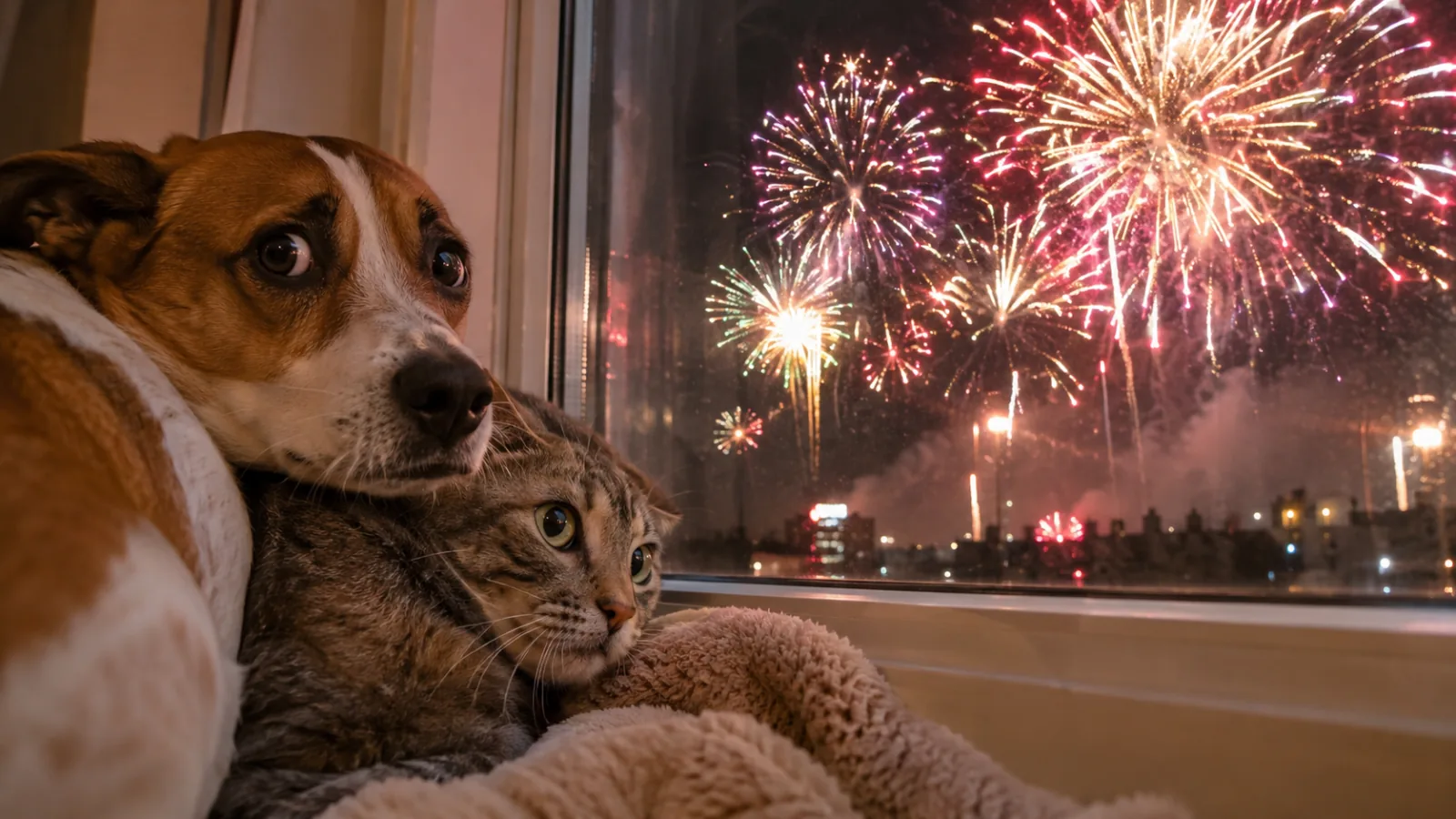
Dogs and cats hear far better than we do, and a bang arrives without warning or explanation. Most pets cope badly. In a 2024 Dutch survey of 3,631 owners, more than three quarters said their dog or cat was afraid during fireworks. One in three dogs and one in seven cats had a phobic level of fear. 64.6% of the cats fled during or just after the fireworks, and 8.4% of cats and 5.4% of dogs had at some point gone missing after fireworks. In the UK, PDSA's PAW Report found that 41% of dog owners say their dog is afraid of fireworks.
The fear does not go away on its own. In an international study of 1,225 dogs, it started before the first birthday in 45% of them, and in more than a quarter of fearful dogs it got worse over the years. Dogs that were gently introduced to loud noises as puppies were clearly less afraid later on.
Dogs run, cats hide
A frightened dog runs, often blindly and far, sometimes across busy roads. A frightened cat usually does the opposite: it crawls into the first safe spot it finds and stays there silently, often for days. That is why cats are often reported missing late. TASSO saw no rise in missing cats on New Year's Day 2024 and puts it down to cats being reported days afterwards. Owners assume the cat will come back on its own, and precious time is lost.
In the weeks before: how to prepare
- Check your microchip registration. A chip only helps if the number is registered with your current address and phone number. In the UK, Check-a-Chip tells you which database holds your pet's number.
- Put an ID tag with your phone number on your dog's collar. A finder will call you long before they take a dog to a vet to be scanned.
- If your pet struggles with loud noises, talk to your vet now. Calming medication, pheromones and training work best when you start weeks in advance.
- Set up a safe den: a crate with a thick blanket over it for a dog, a quiet cupboard or a space under the bed for a cat. Let your pet get used to it now.
- Check your garden. A panicking dog will clear fences it normally ignores and squeeze through gaps you never noticed.
On New Year's Eve itself
- Walk your dog before it gets dark, on a lead, even if they are normally off-lead. If in doubt, use a harness and a collar with two leads.
- Bring your cat in during the afternoon and lock the cat flap. A cat that is outside when the fireworks start will not come back in.
- Close the curtains, leave the lights on and muffle the bangs with the TV, radio or calm music.
- Stay home if you can, and stay calm yourself. It is fine to comfort your pet if they come to you. Never punish fear.
- Later in the evening, only let your dog out on a lead, even in your own garden, and pick a quiet moment.
- Be careful at midnight. When everyone goes out to watch the fireworks, the front door is left open. Shut your pet in a room first.
Having guests? Agree who is in charge of the doors. Many pets do not escape during the fireworks themselves, but because someone opens the door to watch or to head home.
If your pet runs away anyway: how to improve the odds
Start searching straight away, even at night. The fireworks die down quickly, and that is when many animals come out of hiding. In the largest study of lost cats, three quarters were found within 500 metres of home and half within 50 metres. Search close to home first and thoroughly: under cars, in sheds, under bushes and in your neighbours' gardens. A frightened cat often will not answer when you call, so use a torch and listen.
Dogs travel further, but the neighbourhood still matters most: in a large US study, nearly half of recovered dogs were found by searching the local area. Walk your dog's usual routes and ask anyone out on the street whether they saw a dog running.
- Report your pet missing to your microchip database straight away so a found animal can be matched as soon as its chip is scanned. In the UK, that is often Petlog; in Ireland, look your chip up on Fido.ie.
- Phone the shelters and the vets near you. Found pets are often taken there to be scanned. In the UK and Ireland, also contact your council's dog warden.
- Put up posters with a clear photo, and ask neighbours to check their sheds and garages.
- Do not wait to report it, even for a cat. The sooner the neighbourhood knows your pet is missing, the more eyes are looking.
Want as many people as possible around the place your pet went missing to know right away? That is exactly what a Lost Pet Alarm does: start a search campaign for your pet, and the alert reaches people nearby within hours.
For a full step-by-step plan, read our guide on how to find a lost cat.
Has your dog run off? Read how to find a lost dog.
Frequently asked questions
How many pets go missing on New Year's Eve?
Far more than usual. Germany's TASSO registry recorded 457 missing dogs over New Year 2023/2024, almost three times an average day, and the Dutch register Amivedi received 80.5% more missing-pet reports around New Year 2025/2026 than on an average December day.
When should I walk my dog on New Year's Eve?
As early as possible, before dark and before most of the fireworks start, and always on a lead. For a nervous dog, use a harness and a collar with two leads. Later in the evening, only go out on a lead and at a quiet moment.
My cat ran off during the fireworks. Where should I look?
Close to home. Frightened cats hide in the first safe spot they find and stay silent. Three quarters of lost cats are found within 500 metres of home. Search with a torch under cars, in sheds and in neighbours' gardens, and report your cat missing straight away.
Why are more dogs than cats reported missing at New Year?
Dogs bolt and are noticed missing immediately. Cats hide and often come home on their own, so owners tend to wait days before reporting them. Report a missing cat straight away anyway: the sooner people nearby know, the better.
Does comforting my pet make the fear worse?
No. If your pet comes to you for reassurance, it is fine to give it. Stay calm yourself, never punish fearful behaviour and do not force your pet out of its hiding place.